
The Role of ERP in Supply Chain Management for Indianapolis Businesses
Book a Demo Call Talk to Us Today
Every Indianapolis business that moves a product, whether you manufacture it, distribute it, or source and resell it, has a supply chain.
And every supply chain has the same fundamental challenge.
Too many moving parts. Too many places where information gets lost. Too many manual steps between a customer placing an order and that order actually being fulfilled correctly and on time.
For Indianapolis businesses running supply chain operations on disconnected tools, separate systems for purchasing, inventory, warehouse management, and order fulfilment, the cost of that fragmentation shows up every single month. In delayed orders. In overstocked warehouses. In procurement mistakes that ripple through production for weeks.
ERP software solves this at the root. And for Indianapolis businesses specifically, Odoo ERP delivers the supply chain management capabilities that mid-sized companies need at a price point that makes sense.
Here is a plain-language breakdown of what ERP actually does for supply chain management and what it means in practice for your Indianapolis operation.
What Is the Role of ERP in Supply Chain Management?
At its core, an ERP system brings every function of your business, finance, sales, purchasing, inventory, manufacturing, warehouse, and distribution into one connected platform with one shared database.
For supply chain management, that integration is everything.
Supply chains fail when information is siloed. When the purchasing team does not know what the warehouse team is running low on. When the production floor does not have visibility into what is coming from suppliers. When the sales team promises delivery dates that operations cannot meet because nobody looked at current stock levels first.
ERP eliminates those silos. Every department works from the same real-time data. Decisions get made faster, with better information, and with far fewer costly mistakes.
For Indianapolis businesses in construction, logistics, manufacturing, retail, and distribution, this is not a nice-to-have. It is the operational foundation that separates businesses that scale from businesses that plateau.
The Real Cost of Managing Supply Chain Without ERP
Before we talk about what ERP does, it is worth being honest about what running supply chain operations without ERP actually costs Indianapolis businesses.
Manual purchase orders are processed in spreadsheets and approved over email. Each one takes longer than it should, creates version control problems, and leaves no clean audit trail.
Inventory is managed in isolation from sales and production data. The result is classic: you overstock slow-moving items because nobody has visibility into demand trends, and you run out of fast-moving items at the worst possible moment.
Supplier performance is tracked nowhere. You know one supplier is consistently late, but because nobody has tracked it systematically, you keep using them until a major order gets delayed and a customer relationship suffers.
Warehouse operations disconnected from orders. Picking, packing, and shipping processes that depend on manual handoffs and verbal confirmations rather than system-driven workflows.
Every one of these problems is a direct consequence of running supply chain operations without an integrated system. And every one of them is solved when you bring your supply chain into Odoo.
How Odoo ERP Manages Supply Chain, Module by Module
Odoo's supply chain capabilities are built across several modules that work together natively. Here is what each one does for Indianapolis businesses in practice.
Demand Planning and Forecasting
Odoo uses historical sales data, seasonal trends, and sales pipeline information to generate accurate demand forecasts. Your procurement team knows what to order, in what quantities, and when, before you run out.
For Indianapolis businesses with seasonal demand patterns, retail operations ahead of the holiday period, and construction suppliers ahead of the building season, this forecasting capability alone prevents the overstocking and stockouts that drain working capital.
Procurement and Purchase Management
The entire procurement process, from supplier evaluation and bid management to purchase order creation, approval workflows, and delivery tracking, is managed centrally inside Odoo.
Approval hierarchies mean the right people sign off on purchases above defined thresholds automatically. Purchase orders are generated from reorder rules without anyone manually triggering them. Supplier lead times are tracked and factored into replenishment calculations.
For Indianapolis businesses processing dozens or hundreds of purchase orders monthly, automating this process reduces administrative overhead significantly and eliminates the ordering errors that create costly knock-on effects downstream.
Inventory Management
Odoo's inventory module gives Indianapolis businesses real-time visibility into stock levels across every location, warehouse, shop floor, satellite location, or third-party storage.
Reorder rules trigger automatically when stock falls below defined thresholds. Lot and serial number tracking provides full traceability from supplier delivery to customer shipment. Inventory valuation updates in real time and flows directly into the accounting module without any manual journal entries.
The result is a business that always knows exactly what it has, where it is, and what it is worth, without a monthly stock count and a spreadsheet reconciliation to find out.
Warehouse Management
Odoo's warehouse management system streamlines the physical operations of your Indianapolis warehouse. Receiving, put-away, picking, packing, and shipping are all system-guided, reducing the reliance on tribal knowledge and verbal instructions that create errors in busy warehouse environments.
Barcode scanning integrates natively. Multiple warehouse locations are managed from a single interface. Transfer rules automate the movement of stock between locations based on defined triggers.
For Indianapolis logistics and distribution businesses, this is the module that has the most immediate operational impact.
Manufacturing and Production Planning
For Indianapolis businesses that manufacture products rather than simply distributing them, Odoo's manufacturing module connects directly to inventory, purchasing, and sales.
Bills of materials define exactly what is needed to produce each item. Work orders are scheduled against available capacity. Material requirements planning calculates what needs to be purchased based on production schedules and current stock levels.
When a sales order comes in, Odoo can automatically calculate whether you have the materials to fulfil it, what needs to be purchased, and when production needs to start to meet the delivery date. That entire calculation happens in seconds inside the system, not over a two-hour planning meeting.
Supplier Performance Tracking
One of the most underused capabilities in supply chain management is systematic vendor performance measurement.
Odoo tracks on-time delivery rates, order accuracy, lead time consistency, and cost performance for every supplier automatically, because every purchase order and every receipt is recorded in the system. You can compare supplier performance across your entire vendor base at any point and make sourcing decisions based on actual data rather than anecdotal memory.
For Indianapolis businesses managing multiple suppliers for the same category of goods, this visibility is a significant negotiating and decision-making advantage.
Order Management and Customer Fulfilment
The supply chain does not end at your warehouse door. It ends when the customer receives their order correctly and on time.
Odoo connects sales orders directly to inventory availability, warehouse operations, and delivery logistics. When a customer places an order, the system checks stock, triggers picking, generates delivery documentation, and updates the customer record automatically.
Accurate delivery date commitments become possible because they are based on real inventory data rather than optimistic estimates. Customer communication is automated. And your sales team has visibility into order status without having to call the warehouse.
8 Supply Chain Benefits Indianapolis Businesses See After Implementing Odoo
Based on the implementations TND Technology Group has delivered for Indianapolis businesses, here are the eight improvements that consistently show up after Odoo goes live:
1. Procurement errors drop significantly. Automated purchase orders generated from real inventory data eliminate the manual mistakes that come from managing purchasing in spreadsheets.
2. Inventory carrying costs reduce. Accurate demand forecasting means buying what you need rather than what you guess you might need. Less overstock. Less cash tied up in slow-moving inventory.
3. Order fulfilment becomes faster and more accurate. System-guided warehouse operations reduce picking errors and speed up the process from order received to order shipped.
4. Supplier relationships improve. When you have data on supplier performance, conversations with vendors become more productive. You can reward reliable suppliers with more business and address performance issues with specifics rather than impressions.
5. Month-end inventory reconciliation disappears. Because inventory valuation flows directly into accounting in real time, the manual reconciliation process that consumes finance team time every month simply stops being necessary.
6. Visibility across the supply chain becomes real-time. Management can see exactly where every order stands, what is in stock across all locations, and what is coming from suppliers, at any point during the working day, from any device.
7. Scalability improves dramatically. Growing an Indianapolis business on disconnected tools means hiring more people to manage the additional volume manually. Growing on Odoo means the system handles increased volume automatically. The business scales without proportional headcount growth.
8. IT complexity reduces. Instead of maintaining integrations between five separate systems, each with its own vendor, its own update cycle, and its own failure modes, your entire supply chain runs on one platform that TND manages and supports.
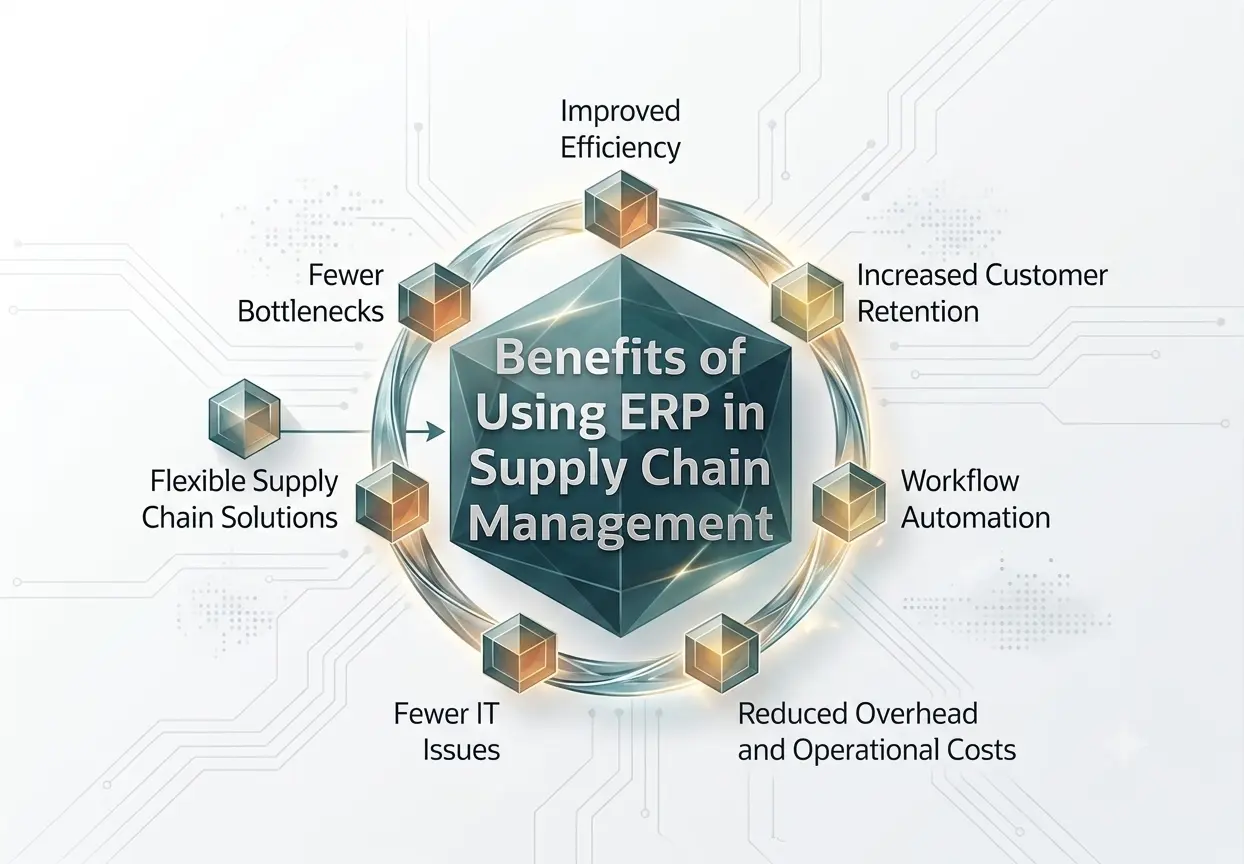
A circular diagram showing the benefits of using ERP in supply chain management. The title appears in the center, with key benefits listed around it, including improved efficiency, workflow automation, reduced costs, fewer IT issues, flexible supply chain solutions, fewer bottlenecks, and increased customer retention.
What ERP Implementation Looks Like for Indianapolis Supply Chain Businesses
The most common concern Indianapolis business owners raise about ERP implementation is disruption. Supply chain operations cannot stop for a software rollout. Orders still need to ship. Suppliers still need to be paid.
This is exactly why TND Technology Group uses a phased implementation approach for every supply chain deployment.
Phase one focuses on the highest-impact area first, typically inventory and purchasing, because these deliver immediate operational improvements and lay the data foundation for everything that follows.
Phase two brings in warehouse management and order fulfilment once the team is confident in the inventory layer.
Phase three adds manufacturing, demand planning, or additional modules based on what the business needs.
At no point is the entire operation migrated simultaneously. Each phase runs in parallel with existing tools until go-live confidence is established. The transition is managed, not forced.
TND Technology Group has delivered Odoo implementations for Indianapolis businesses across construction, logistics, distribution, retail, and manufacturing. We start every supply chain engagement with a free Systems Mapping Call, where we map your current operation, identify exactly where Odoo adds the most value for your specific supply chain, and give you a realistic picture of what implementation involves.
The Bottom Line
Supply chain management is complex. The businesses that manage it well, consistently meeting customer commitments while controlling costs and maintaining supplier relationships, are the ones with the clearest visibility into what is happening across their entire operation.
That visibility comes from integration. And integration comes from ERP.
For Indianapolis businesses ready to move their supply chain off spreadsheets and disconnected tools and onto a connected platform, Odoo is the most practical, cost-effective, and scalable path forward available today.
Ready to See What Odoo Looks Like for Your Indianapolis Supply Chain?
TND Technology Group is an Indianapolis-based Odoo implementation partner with over 21 years of experience helping local businesses build connected, efficient operations.
Book a free 60-minute Systems Mapping Call. We will walk through your current supply chain setup, show you specifically where Odoo delivers the most value for your operation, and give you a clear, honest picture of what implementation involves, including timeline and cost.
If Odoo is not the right fit, we will tell you that too.
No pitch. No pressure. Just clarity.
Supply Chain in ERP FAQs
Is supply chain management part of ERP?
Leading enterprise resource planning (ERP) systems typically support supply chain management (SCM) activities, including planning, procurement, manufacturing, inventory management and order management. ERP software also supports a comprehensive set of other business functions, including finance, payroll and customer relationship management (CRM).
How does ERP affect supply chain management?
ERP improves supply chain management by supporting key supply chain processes — from planning and procurement to logistics — and increasing efficiency through integration and automation. ERP systems that provide global visibility into supply chain operations also facilitate better decision-making, helping businesses optimize operations and reduce costs.
How does ERP fit with ecommerce and supply chain management?
Supply chain management plays an integral role in any ecommerce operation, as retailers must source, store, deliver and accept returns for their products — often across a global network of suppliers and customers. ERP software helps retailers optimize inventory management, warehouse management, logistics and more so they can deliver on customer expectations while keeping costs in check.
What can ERP do for your supply chain?
ERP systems bring visibility and automation to supply chain management. With insight into real-time data from across the supply chain, stakeholders can make better-informed decisions about how to manage functions, from procurement to inventory management. Automation accelerates supply chain operations, leading to both time and cost savings, while reducing the risk of human error.
What does ERP stand for in a supply chain?
ERP stands for enterprise resource planning. ERP systems are all-in-one business software suites that help organizations manage a broad range of functions, from payroll and production to sales. Leading ERP systems support supply chain management functions, such as planning, procurement, inventory management and manufacturing.
Is ERP the key to supply chain success?
Supply chain management can be extremely complex, especially for companies dealing with complex networks of suppliers. ERP can significantly improve supply chain processes by making them more scalable, efficient and easy to manage. These systems help businesses integrate data from across the supply chain, streamline and automate key processes and gain better supply chain visibility to help improve efficiency and respond to problems.
How can ERP systems improve supply chains?
ERP systems consolidate and deliver global visibility into supply chain data, giving businesses a holistic, real-time picture of performance so they can quickly make informed decisions to improve operations and respond to challenges. ERP systems also automate essential supply chain functions, accelerating responsiveness while reducing the administrative burden and risk of human error.
TND Technology Group Inc. is an Indianapolis-based IT solutions company specialising in Odoo ERP implementation, managed IT services, and Sangoma business communications for small and mid-sized businesses. 3815 River Crossing Parkway Suite 100, Indianapolis, IN 46240.