Odoo vs NetSuite: Which ERP Is Right for Indianapolis Small Businesses?
If you're researching ERP software for your business, you've probably come across both Odoo and Oracle NetSuite.
Both are legitimate platforms. Both have real customers. Both will show you polished demos and compelling case studies.
But they are built for fundamentally different businesses, and choosing the wrong one is an expensive mistake that Indianapolis SMBs make more than they should.
This guide gives you an honest comparison. Not a sales pitch. The information you need to make a decision that actually fits your business, your team, and your budget.
Where Each Platform Comes From, Because Origin Matters
Before comparing features, it's worth understanding the DNA of each platform.
Odoo started as open-source software built to disrupt enterprise ERP. The premise was simple, most ERP systems were too expensive, too complex, and too rigid for growing businesses. Odoo set out to build something different: a modular, integrated platform covering every business function at a price point small and mid-sized businesses could actually afford.
Today Odoo has more than 12 million users globally, 44,000+ integrated apps, and a thriving open-source community that continues expanding the platform.

Oracle NetSuite took the opposite path. It was one of the first cloud-native ERP systems, built for mid-market and enterprise companies from day one. Oracle acquired it in 2016, cementing its position as a serious enterprise platform with global financial capabilities, multi-entity support, and Oracle's backing.

The key difference: Odoo was built up from SMBs. NetSuite was built down from enterprise. That distinction shows up in every aspect of how the platforms work in practice, and more importantly, in what they cost.
Pricing: Where Most NetSuite Conversations End for Indianapolis SMBs
Let's be direct about the numbers because pricing is often where this decision gets made quickly.
Odoo offers a free Community Edition for businesses that want to self-implement. The Enterprise edition, which includes premium modules, official support, and the full feature set, starts around $20–40 per user per month depending on configuration. For most Indianapolis SMBs the total platform cost is highly manageable.
NetSuite starts with a base subscription typically quoted around $999 per month, before adding user licenses at $99–$999 per user per month depending on role, and before adding module costs on top.
For a 15-person Indianapolis business, the monthly comparison looks something like this:
- Odoo Enterprise: approximately $600–$900 per month
- NetSuite: approximately $3,000–$5,000 per month
That gap compounds over years. And that's before implementation costs, which for NetSuite are typically higher given the specialist consultants required.
For most Indianapolis SMBs, this pricing reality ends the NetSuite conversation before it starts. Which is not a criticism of NetSuite, it's simply not built for businesses at this scale.
Features: Where Odoo Consistently Pulls Ahead for Growing Businesses
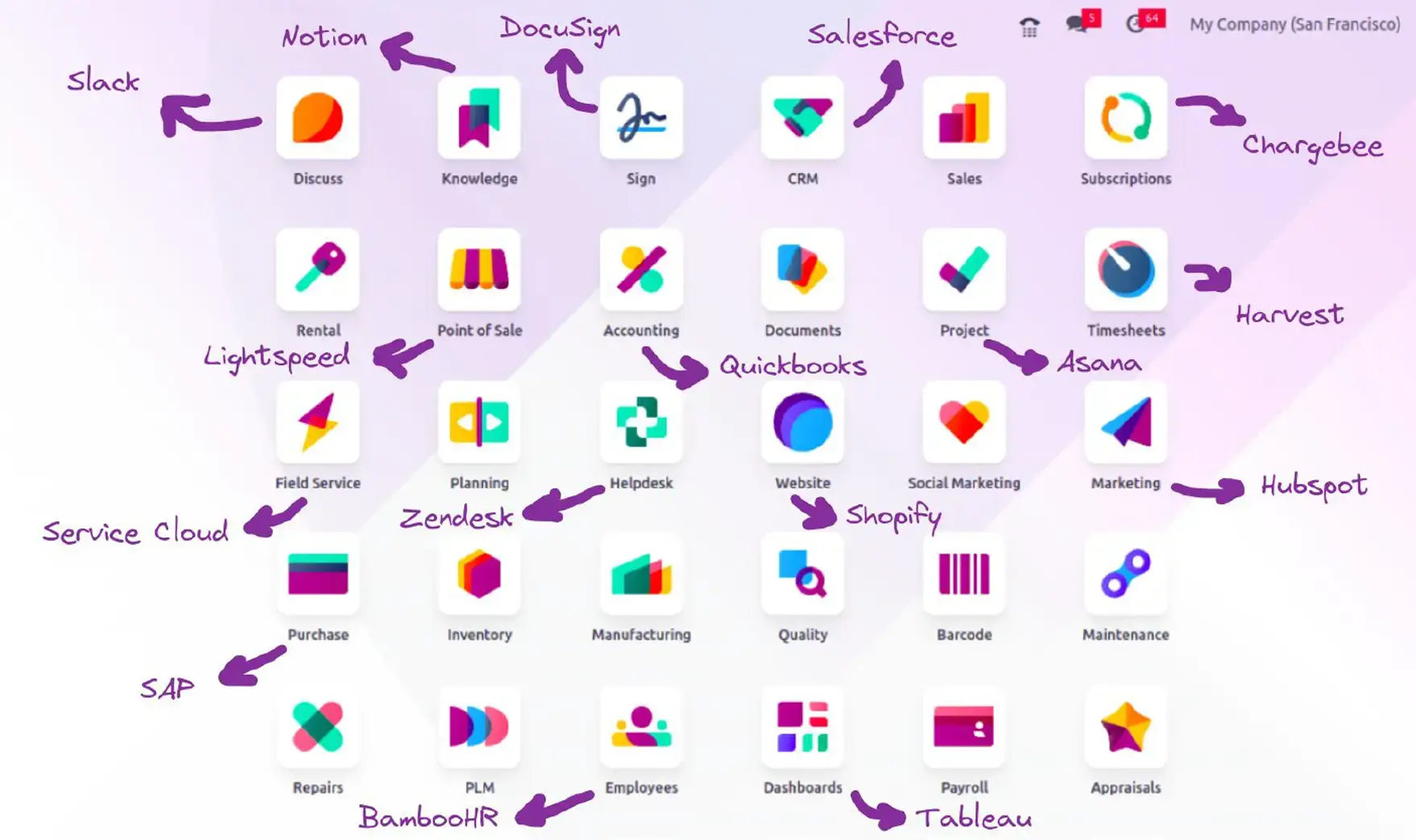
On raw features, both platforms cover the core ground, accounting, CRM, inventory, order management, reporting, and more. But meaningful differences emerge when you look closely.
Flexibility and Modularity
Odoo is designed for phased implementation. You start with the modules you need, accounting and CRM, for example, and add inventory, HR, manufacturing, and eCommerce as your business grows. Each module is built to integrate seamlessly with the others. No heavy configuration required.
NetSuite's integrated architecture is more rigid. It is designed to be implemented as a comprehensive system rather than built up incrementally. For businesses with well-defined, complex requirements from day one, this works well. For growing Indianapolis SMBs that want to start lean and expand, it works against you.
Integration
This is Odoo's biggest practical advantage for small businesses.
When a sale is confirmed in Odoo, inventory updates, an invoice is generated, and the accounting entry is created. Automatically. No one copying anything from one system to another.
NetSuite's modules are integrated but the cross-module automation is less seamless for standard SMB workflows. For businesses trying to eliminate the manual handoffs between disconnected systems, Odoo's native integration is the more practical solution.
Beyond Traditional ERP
Odoo includes tools that traditional ERP systems, including NetSuite, don't offer out of the box.
A website builder. An eCommerce store connected directly to inventory. Email marketing automation. Point of sale. Social media management.
For an Indianapolis retail business or an SMB with an online sales channel, having these functions integrated into the same platform as accounting and inventory is a significant operational advantage.
Global and Multi-Entity Capabilities
This is where NetSuite genuinely leads.
If your Indianapolis business operates across multiple countries, manages multiple legal entities, or needs sophisticated multi-currency consolidation and international tax compliance, NetSuite's architecture handles this better than Odoo out of the box.
For most Indianapolis SMBs with 5 to 100 employees operating in Indiana — this capability is not a requirement. But it's worth naming honestly.
Implementation: What Getting Started Actually Looks Like
Choosing the software is one decision. Getting it live and running is another.
Odoo implementation with a qualified Indianapolis partner typically takes 8–14 weeks from scoping to go-live for a standard SMB deployment. The phased approach, start with core modules and expand, keeps risk low and gives your team time to adapt. TND Technology Group begins every Odoo engagement with a free Systems Mapping Call before a single module is configured. We map your actual workflow, identify where Odoo fits, and give you a fixed-price proposal before any work begins.
NetSuite implementation is a larger project by design. Most deployments involve Oracle-certified consultants, longer timelines, often three to twelve months depending on scope, and higher professional services costs. The system is powerful when properly configured but the path to go-live is more resource intensive.
For an Indianapolis SMB without a dedicated IT department, the implementation experience difference between the two platforms is significant.
The Honest Assessment: When Does NetSuite Make Sense?
In the interest of a fair comparison, there are situations where NetSuite is the stronger choice.
If you operate across multiple countries or have multiple legal entities, NetSuite's global financial consolidation and international compliance capabilities are genuinely superior.
If your primary clients are large enterprise companies that require NetSuite integration for supply chain or procurement reasons, the ecosystem alignment has real value.
If your business has already outgrown Odoo's standard capabilities and requires highly complex financial reporting at enterprise scale, NetSuite's Oracle backing and mature feature set may justify the investment.
For the vast majority of Indianapolis SMBs, businesses with 5 to 100 employees in retail, construction, logistics, health and fitness, hospitality, or supply chain, none of these conditions apply. The cost premium, implementation complexity, and rigidity of NetSuite create more friction than value at this scale.
The Bottom Line
| Odoo | NetSuite | |
| Starting cost | ~$20–40/user/month | ~$999/month base + user fees |
| Implementation time | 8–14 weeks | 3–12 months |
| Deployment | Cloud, on-premise, or hybrid | Cloud only |
| Modularity | Start small, grow incrementally | Full suite, larger initial scope |
| Integration | Native, seamless | Strong but more structured |
| Best for | SMBs 5–500 employees | Mid-market and enterprise |
| Built-in website/eCommerce | Yes | Via Suite Commerce add-on |
| Indianapolis partner | TND Technology Group | — |
For most Indianapolis small and mid-sized businesses, Odoo is the stronger choice, on pricing, flexibility, integration, and implementation practicality. NetSuite is a powerful enterprise platform with a specific use case, but the cost and complexity premium it carries is difficult to justify for businesses under 100 employees without specific global or multi-entity requirements.
Ready to See What Odoo Looks Like for Your Business?

The best way to evaluate any ERP system is to see it mapped against your actual operations, not a generic demo.
TND Technology Group is an Indianapolis-based Odoo implementation partner. We offer a free 30-minute Systems Mapping Call for Indianapolis businesses. We'll walk through how your business currently runs, identify where Odoo can genuinely add value, and show you specifically what implementation would look like for your business. If it's not the right fit, we'll tell you honestly.
No pitch. No pressure. A clear answer either way.
👉 Book your Free Odoo Consulting Call Today